

India’s food delivery market fulfils 5-6 Mn orders every day vs. 150+ Mn orders in China. Market leader Meituan today does 66 Mn food delivery orders every day in China, which is over 25 times more than Zomato’s daily orders. Despite having a digitized economy, high UPI penetration & over 300 Mn ecommerce transacting users, why does it feel like India’s food delivery market is still limited to the top 5 percentile of the country today?
Add to this the fact that India has abundant labour, which keeps wages low, whereas China no longer enjoys that advantage. I do note that eating outside food is still the exception rather than the norm for the majority of India, whereas people in China and the USA are more open to consuming food outside regularly. People aged 18-35 order food once a day on average in China (I wonder how many years it will take for India to reach that level of frequency, if ever). But I am also sure there are some structural business differences that are capping India’s ordering potential.
In today’s writeup, I argue why Zomato should be pressing the pedal hard to accelerate user growth and frequency by bringing down its per-order value, essentially expanding the market and unlocking the top 20 percentile of city-residing India, before any competitor forces them to do so. I will discuss the per-order economics, how Chinese giants like Meituan brought down delivery costs, and what Zomato should be aiming for. Would suggest to read today’s writeup on the website here for better reading experience.
The Case for Lower Delivery Costs
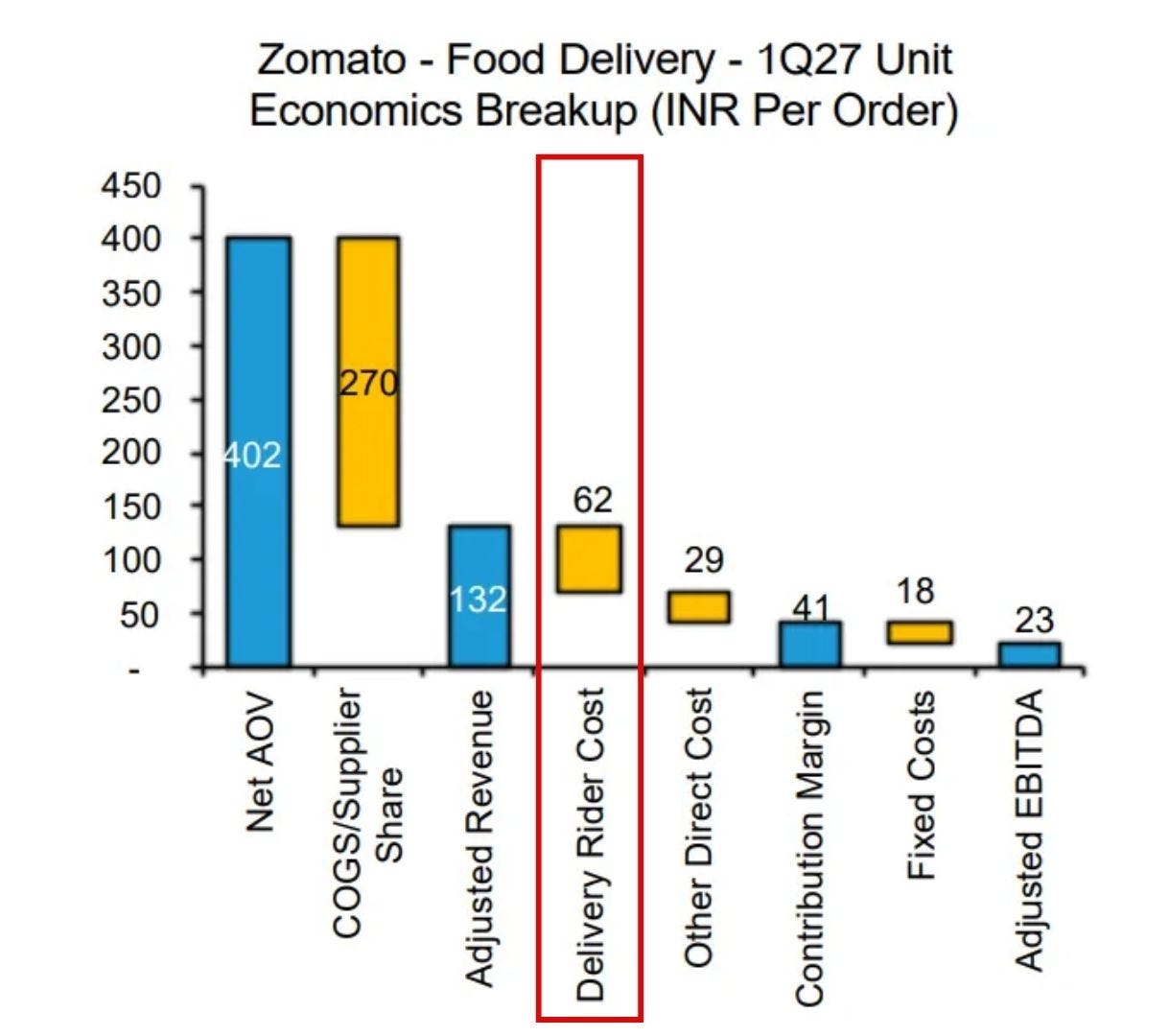
Zomato reported an adjusted EBITDA margin of 5.6% of net order value in its latest quarterly (Q1 FY27) results, implying that on every ~Rs 400 order, they now earn Rs 23 as profit. This, multiplied by the 2.5-3 Mn orders they fulfil daily, now helps them earn north of Rs 600 Crores in adjusted EBITDA from this vertical every quarter.
This 5.6% margin is already at the upper end of the steady-state guidance of 5-6% of NOV provided by management, and many analysts now wonder if there is upside risk to their guided number?
Let’s get deeper into the maths first. On an average order value of Rs 402, Zomato earns roughly 33% as revenue, primarily from:
Restaurant commissions
Advertising income
Platform fees
This sums to Rs 132. While they have been pushing this upwards for some time now by charging more from restaurants or increasing platform fees for customers (which is already Rs 18 including GST), I see both adversely impacting the size of supply and demand if pushed beyond a threshold that may not be too far away.
From a cost reduction perspective, we have 3 main costs:
‘Delivery Rider Cost’ (roughly half of revenue, which I discuss below)
‘Other Direct Costs’, which include platform-funded discounts, payment gateway charges, customer support and refunds. They are trying to bring down some of these costs with the help of AI and reduced discounts over time.
‘Fixed Costs’ like employee salaries, which will continue to reduce on per order basis with scale over the years.
Now, coming to delivery rider costs:
It stood at ~Rs 45 per order in FY21 as per their DRHP made public in 2021 before the IPO, which has grown to Rs 62 today.
One would assume that this would continue to go up based on wage inflation in the country, but if they can somehow solve for this by bringing it down while maintaining the overall earnings of a rider, the economics of food delivery would look drastically different.
Why am I focusing on this? Suppose this cost comes down to Rs 45. They can earn the same EBITDA per order at a revenue per order of Rs 115. This would also essentially mean that, to earn the current level of margins on their food, restaurant owners could offer their menu at ~15% lower rates.
Lower menu rates imply a lower hurdle for ordering food from outside, which could essentially unlock a large segment of the digitally savvy population that cannot afford to spend Rs 400 on one meal. This is essentially how China has solved for it and seen massive volumes, which I shall be focusing on next.
Batch Your Orders Nicely
Imagine bundling 5 drop-offs into one trip for Rs 200 in total delivery partner payout because there’s a customer segment willing to trade speed for a steep discount, at scale, across the same city blocks. That’s a norm in China but doesn’t happen in India.
The key point is that delivery cost is largely driven by the trip, not by the value of the order. A rider spends roughly the same amount of time and effort travelling from the restaurant to the customer whether the order is worth ₹150 or ₹800. The platform therefore gets little additional delivery efficiency from a higher-value order.
Bundling changes this equation. If a rider can deliver five orders on roughly the same route instead of making five separate trips, the underlying trip cost is spread across all five orders. The customer still pays for delivery on each order, so the platform does not necessarily have to give up delivery revenue, but its cost per order falls sharply. What was previously one rider, one trip and one delivery cost can now become one rider, one route and five deliveries. Bundling essentially allows the same delivery revenue to be supported by a much lower cost per order for the company.
But batching only works above a certain density threshold. To pair two orders, the platform needs two live orders whose pickup points and drop-off points are close enough in both space and time that combining them saves more distance than it adds. Below a certain order-per-square-kilometre threshold, there is simply nothing nearby to pair with, and the dispatch algorithm ends up assigning one rider to one order regardless of intent.
That’s the lever India’s market hasn’t pulled yet because order density per neighbourhood isn’t high enough, but China already has. As a result, the model effectively plays out in two distinct formats, depending on how much speed the customer is willing to trade off:
Batch delivery: Riders carry multiple orders at once. The pay per order is lower, but the higher volume leads to higher overall earnings. These deliveries usually take 40-50 minutes.
One-on-One premium service: Riders take only one food delivery at a time, offering much faster delivery of around 20 minutes.
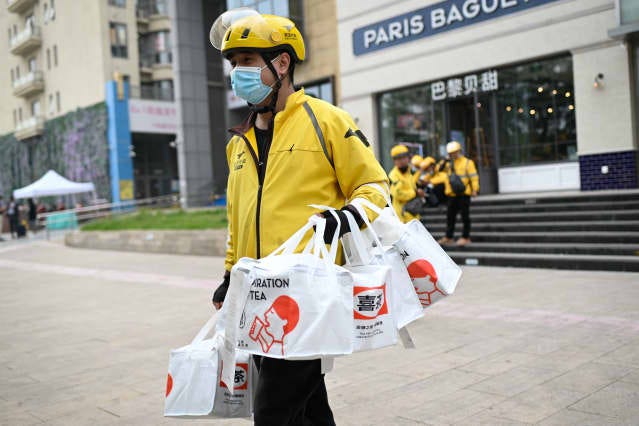
Majority of riders and customers gravitate towards the first model. During rush hours, riders end up carrying 4-5, sometimes 6, orders in a single trip, a direct function of high order density and demand clustering across the same few city blocks at the same time. Riders who consistently hit these batch volumes end up earning up to 50% more than riders in the one-on-one model.
Total time on the road ends up being similar either way. The batch rider isn’t working longer hours, but the job is certainly more exhausting, as they spend that time moving between multiple drop-offs instead of waiting. In the one-on-one model, a meaningful chunk of a rider’s shift can go into waiting for the next single order to come in, particularly during off-peak hours.
While Zomato has not differentiated its fleet on this basis yet, it has been batching orders during peak times for a while now, but only limited to 2-3 orders at a time. Even this is largely restricted to high-demand periods and situations where the orders are picked up from the same restaurant.
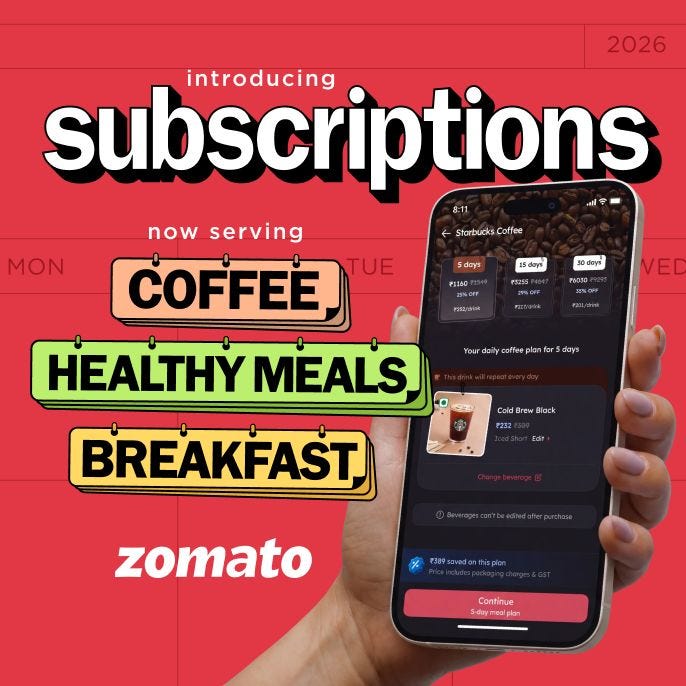
But one recent attempt that caught my attention is their ‘Subscriptions’ offering, where the delivery time/day, restaurant, as well as the food item, are pre-decided by customers. Food items here are available at ~25-40% lower prices with no major additional charges. They started by offering this for their ‘Healthy Mode’ meals, but likely seeing good traction, they have now expanded it to coffee, breakfast and homely food options. In one of their posts, they also shared that, surprisingly, their 15-day meal plans are outperforming the 5-day plans.
This is a classic case where batching + efficient fleet optimization become much easier when you have advance visibility into upcoming deliveries.
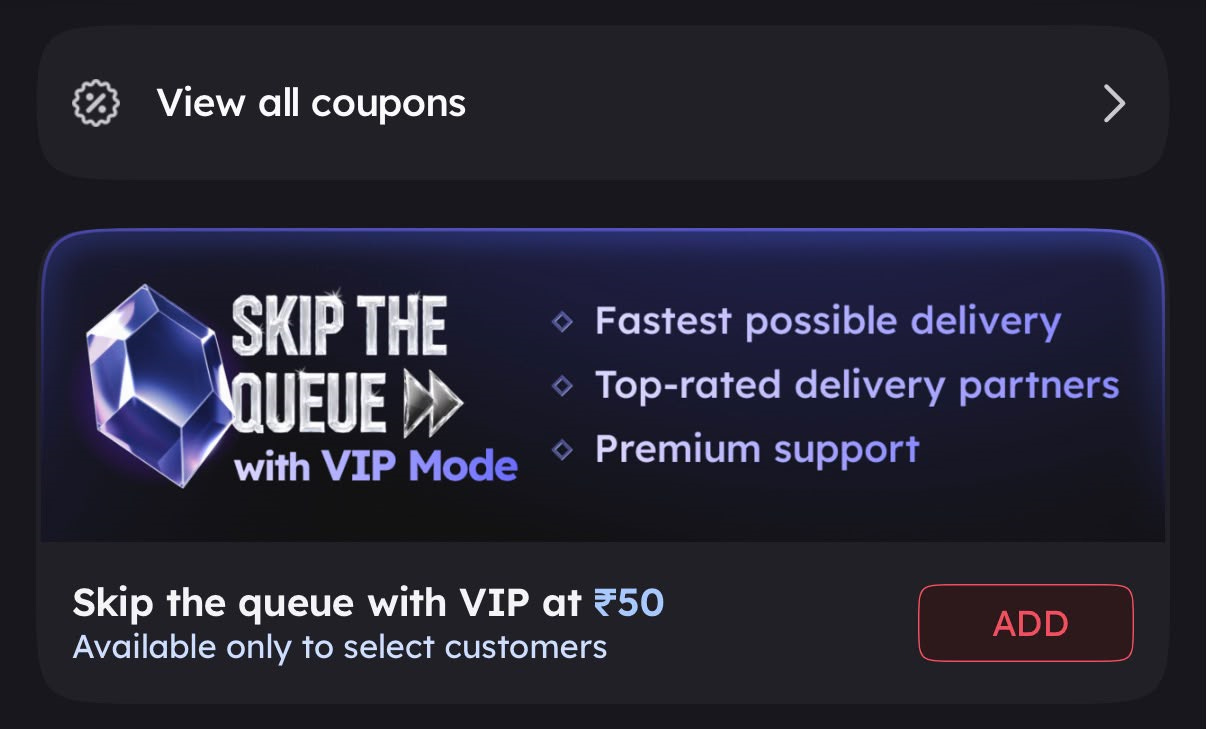
At the same time, they have been pushing the so-called ‘VIP Mode’ for an extra charge, with the promise of faster delivery, which is very similar to China’s ‘One-on-One premium service’, where delivery happens in ~20 minutes. This essentially means Zomato may already be moving towards a miniature two-tier delivery model without explicitly packaging it that way.
Subscriptions look a lot like the batching-friendly tier. By locking in the restaurant, item and delivery slot in advance, they provide visibility ahead of time, making it much easier to plan and batch deliveries efficiently. VIP Mode, on the other hand, caters to customers willing to pay more to stay out of the batching pool and get a dedicated single-order trip.
Essentially, if Zomato can successfully segregate its value-seeking & speed-seeking customers, it could not only maintain its current pool of loyal customers but also unlock a new set of customers who are currently deterred by price.
Batching in India can take longer delivery timings and therefore can also adversely impact customer experience. Hence, the right balance between delivery time, order flow and routing will have to be struck over time while moving towards more batching, also depending on the nature of the food being delivered.
Skip the Doorstep
Food-delivery lockers are already a common part of the delivery ecosystem in China, particularly in dense residential communities, office complexes and campuses. Instead of a rider taking every order all the way to the customer’s doorstep, multiple orders are delivered to a shared locker or pickup point. The customer then receives a notification and walks to the locker to collect the order using a code or app.
Rather than making five separate trips to five different apartments, a rider might end up dropping all five orders of nearby buildings at the same location in a single stop. The customer gives up a little convenience in exchange for a lower ordering cost, while the platform gets to serve more orders with the same rider and route. In some cases, the rider may also share a small portion of the delivery income with the platform in exchange for the efficiency gained from consolidated deliveries.
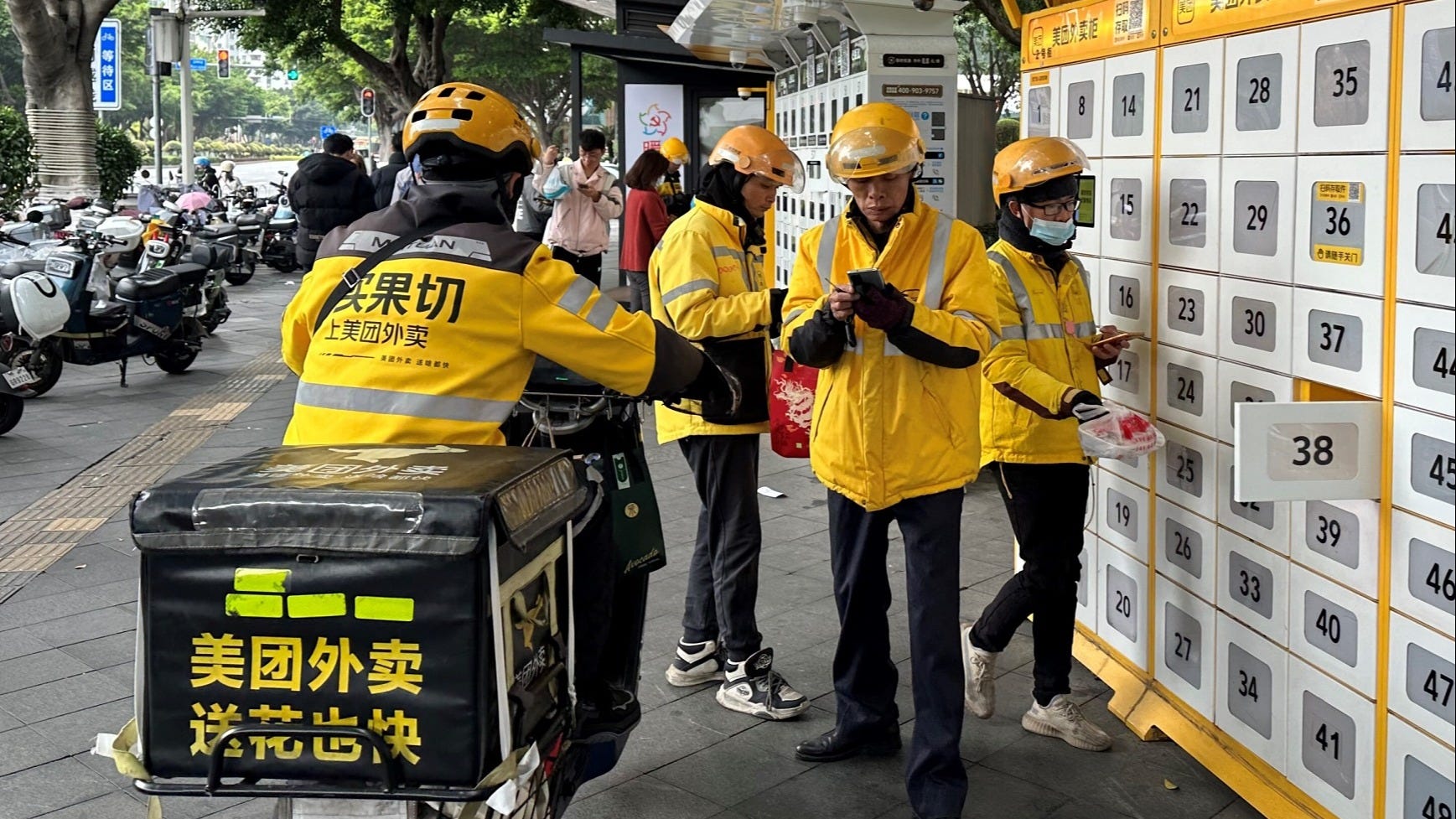
This basically attacks one of the most expensive parts of food delivery: the last few hundred metres and the one-rider-one-order handoff. By consolidating multiple deliveries at a common pickup point, lockers increase route density and allow a single rider to serve several orders at once. And in delivery, density is everything. The more orders that can be served along the same route, the lower the cost per delivery becomes.
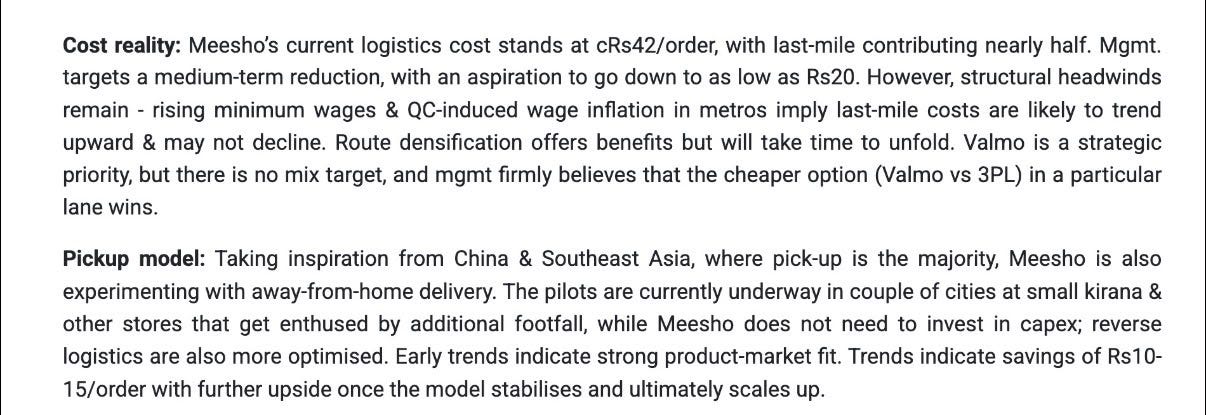
In India, this concept is yet to take shape in food delivery in any meaningful way, as it might require sufficient density of food orders to justify the cost of setting it up. But companies like Meesho, a value-focused ecommerce player, are already applying this logic through Valmo, its in-house logistics arm, which ties up with local kirana stores, pharmacies, and telecom shops as pickup points for customer orders. Their recent acquisition of Kirana Club is in this direction which gives them access to Kiranas in far away tier-4 cities.
At core, the aim here is the same as China's lockers, bringing down the last mile cost, which is the highest in the whole supply chain.
Alongside this, e-2Ws in China are near-universal among delivery riders. Virtually all of Meituan’s roughly 7.45 million riders run on electric bikes or scooters. The running cost of a petrol scooter is roughly Rs 2.75-3 per km, including maintenance, compared with Rs 0.20-0.50 per km for home-charged EVs and around Rs 2 per km all-in for leased EVs with a swappable battery.
Zomato, on the other hand, has committed to 100% EV adoption by 2030 and is running partnerships with Yulu, SUN Mobility and Zypp Electric to get riders onto leased e-2Ws with swap access. However, only about 10% of Zomato’s delivery staff today rides EVs, and swap density is nowhere near China’s.
Meituan has also been running drone delivery since 2017 and now positions it as low-altitude logistics infrastructure with a “ground-air synergy” model. By the end of 2025, it operated 70 routes across cities including Shenzhen and Shanghai and had completed over 780,000 orders, with drone volumes nearly doubling in 1H26. But against 66 Mn daily orders at Meituan, it is still minuscule.
Why Zomato Must Act Now?
It is true that Zomato has strong brand recall and customer stickiness, which has been a structural advantage for the company. It has also already reached Rs 2,500 Crores in annual EBITDA, becoming a stable cash generator for its parent, Eternal. But this highly stable and strongly growing profit pool is also attracting new competitors who want to take away a portion of it.
We are seeing attempts from Swiggy’s Toing, Rapido’s Ownly, and even Flipkart entering this space. At their core, they are not doing anything fundamentally new, but are initiating another discounting war with the intent of attracting the value-conscious pool of potential customers, particularly the top 20 percentile I referred to above, who aren’t used to ordering daily but might start ordering if the threshold is lower.
While batching more orders together may impact customer satisfaction due to longer delivery times, which is crucial in the food-delivery business, a calibrated approach with more new initiatives that help predict demand better and, in turn, optimise the fleet more efficiently could be the way forward.
Therefore, in my opinion, Zomato should look to answer the structurally high delivery cost question of how it can bring down the delivery cost per order, which could eventually create a stronger moat for the company while also accelerating order-volume growth.
Let me know your thoughts in the comments below or reply to my email. I read all my replies.
Disclaimers-
This isn’t investment advice but my personal thought process; DYOR (do your own research); Investing & trading are subject to market risk; the decision maker is responsible for any outcome. This blog is in no way related to my employer.
Read my recent post:
